
mRNA Therapy as a Bridging Strategy in Adrenoleukodystrophy (ALD): Stabilizing Patients While Awaiting Curative Treatment
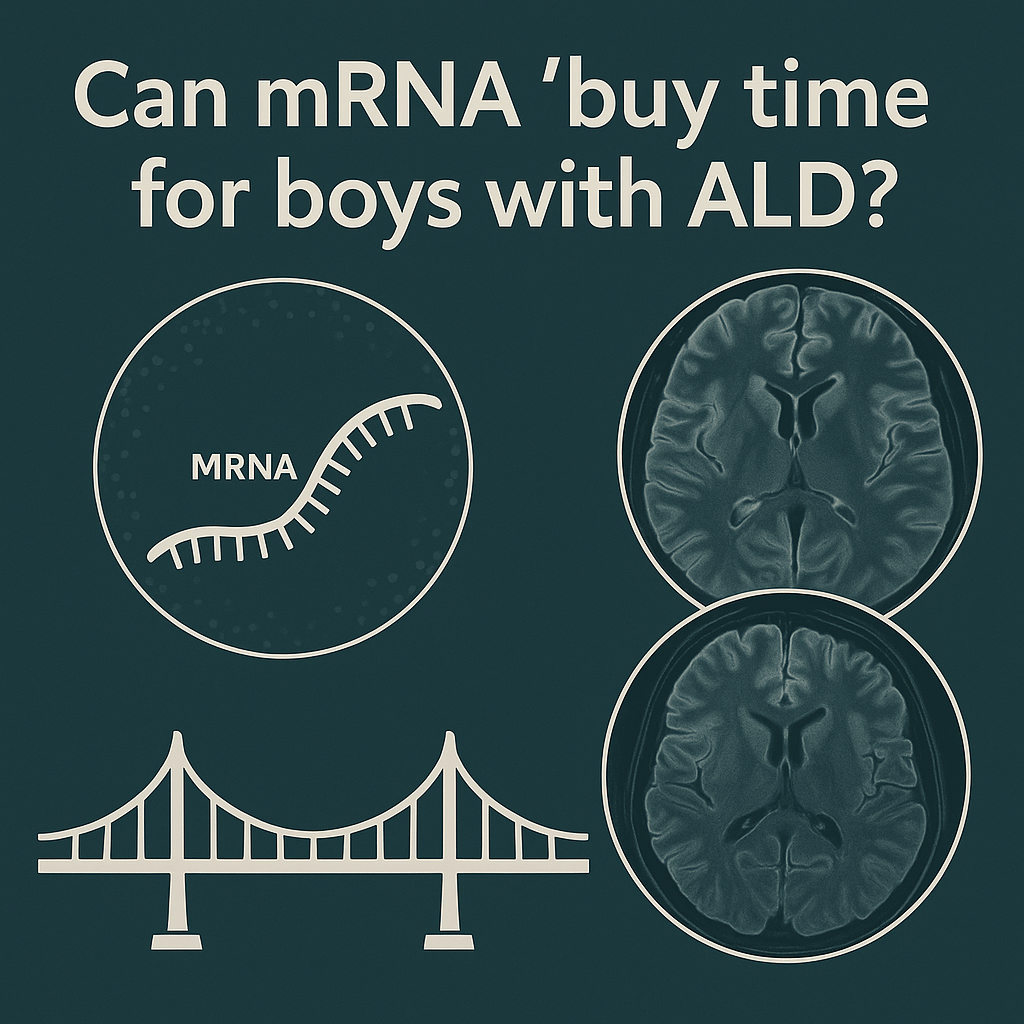
For boys with cerebral adrenoleukodystrophy (cALD), prognosis is determined as much by timing and logistics as by biology. Once demyelinating lesions appear on MRI, the therapeutic window in which allogeneic hematopoietic stem cell transplantation (HSCT) can halt disease is narrow. Lentiviral gene therapy offers an alternative disease-modifying approach, but is limited by cost, infrastructure, and restricted geographical availability. In many real-world settings, children deteriorate neurologically while donor searches, referral pathways, or financial approvals are still in progress.
The intention of this concept is not to compete with HSCT or gene therapy. These remain the definitive options when available in time. Rather, this perspective explores whether ABCD1 mRNA therapy could serve as a temporary, biologically rational “bridge” — aimed at stabilizing the disease and “buying time” until a curative intervention becomes feasible.
Pathophysiological Rationale
ALD is caused by pathogenic variants in ABCD1, encoding the peroxisomal ATP-binding cassette transporter ALDP. Loss of ALDP impairs peroxisomal import and β-oxidation of very long chain fatty acids (VLCFAs), leading to accumulation of C26:0 species in plasma and tissues, and — critically — in the CNS. This biochemical disturbance is tightly linked to neuroinflammation, demyelination, and axonal loss.
The mechanistic logic for mRNA therapy is direct:
- Exogenous ABCD1 mRNA is delivered to patient cells (e.g., via lipid nanoparticles [LNPs] or engineered extracellular vesicles [EVs]).
- Host ribosomes translate the mRNA to produce ALDP.
- ALDP is targeted to the peroxisomal membrane and partially restores VLCFA transport and metabolism.
- Resulting reduction in VLCFA burden may attenuate downstream inflammatory and neurodegenerative cascades.
Unlike viral gene transfer, mRNA is non-integrating, transient, and redosable. While this profile is suboptimal for lifelong monotherapy, it is potentially ideal for a time-limited bridging intervention over 6–24 months.
Lessons from mRNA Therapy in Metabolic Disease
Over the past five years, multiple preclinical programs have validated systemic mRNA therapy in monogenic metabolic disorders:
- Glycogen storage disease type Ia (GSD1a): LNP-formulated G6PC mRNA restored euglycaemia and prevented hepatic tumour formation in mice (Cao et al., Nat Commun 2021).
- Crigler–Najjar syndrome type I: UGT1A1 mRNA normalized bilirubin levels in murine models (Greig et al., Mol Ther Methods Clin Dev 2023).
- Hereditary tyrosinaemia type I (HT1): FAH mRNA improved survival and metabolic parameters in a mouse model (Cacicedo et al., J Inherit Metab Dis 2022).
- Methylmalonic acidemia (MMA): Next-generation MMUT mRNA increased enzyme expression ~3-fold and corrected metabolite profiles in two mouse models (Coughlan et al., Mol Genet Metab 2024).
- Arginase deficiency: Intermittent LNP-mRNA dosing not only corrected plasma biomarkers but also mitigated leukodystrophy-like white-matter changes (Khoja et al., Mol Ther Nucleic Acids 2022).
- Fabry disease, acute intermittent porphyria, and others: Enzyme-replacement style mRNA approaches have demonstrated robust activity in mice and non-human primates.
- Exosome-mRNA delivery: EV-encapsulated mRNA has been used to express GPIHBP1 and lower triglycerides in vivo, illustrating the feasibility of non-LNP carriers.
Collectively, these data show that (1) liver-directed or systemic mRNA delivery can correct specific enzymatic deficits, (2) repeat dosing is practicable, and (3) EV-based delivery can complement or extend LNP platforms, including in contexts where CNS access is relevant.
ALD fits this paradigm: single-gene defect, quantifiable toxic metabolite (C26:0), and clinically meaningful MRI and functional endpoints.
Conceptual Framework: “Peripheral-First → Early CNS” Bridge
A clinically realistic mRNA-based bridge for ALD might follow a stepped approach:
- Peripheral stabilization (AMN / pre-cALD)
- Initiation of systemic LNP–ABCD1 mRNA to lower VLCFAs in plasma, adrenal glands, and peripheral nervous system.
- Serial monitoring of C26:0 levels, adrenal function, serum neurofilament light (NfL), and functional scores.
- Objective: reduce systemic metabolic and inflammatory stress and delay conversion to rapidly progressive cerebral disease.
- Early cerebral involvement (very-early cALD)
- Once MRI demonstrates early demyelinating lesions and the patient is being evaluated for HSCT or gene therapy, bridge dosing is continued.
- To enhance CNS exposure, several strategies could be explored:
- Brain-tropic LNPs with optimized lipid composition and surface ligands.
- Intranasal or intrathecal EV-ABCD1 mRNA formulations.
- Combination of IV LNP/EV-mRNA with transient blood–brain barrier modulation (e.g., focused ultrasound with microbubbles) in specialized centers.
- Here, the therapeutic goal is modest but clinically crucial: slowing lesion expansion and neuroinflammation long enough for HSCT/gene therapy logistics to be completed.
- Stopping rules and safety framework
Because mRNA is inherently temporary, the risk–benefit balance can be managed dynamically. Continuation criteria could integrate:- Magnitude and durability of VLCFA reduction.
- Trends in MRI lesion volume, NfL, and clinical scores.
- Safety signals (transaminases, complement activation, cytokine release, anti-mRNA or anti-LNP immune responses).
Clear discontinuation rules can be specified once a curative intervention is performed or if predefined safety thresholds are reached.
Why a Bridging Strategy Is Clinically Relevant
In an ideal world, all children with very-early cALD would access HSCT or gene therapy at precisely the right time. In reality:
- Donor identification and transplant scheduling are often delayed, particularly in low- and middle-income settings.
- Gene therapy is currently limited to a small number of specialized centers, characterized by complex referral and reimbursement processes.
- Families may live far from these hubs or in health systems where advanced therapies are not available.
In this context, a standardized, redosable mRNA protocol — even if administered only in regional centers — might be significantly more deployable than autologous gene therapy or urgent HSCT. Even a partial reduction in VLCFAs and a modest slowing of lesion progression could translate into additional months of preserved neurological function, which is clinically and ethically meaningful.
Outlook and Call for Collaboration
From a technical standpoint, many pieces are already in place:
- Design of optimized ABCD1 mRNA (Cap-1, modified nucleosides, engineered 5′/3′UTRs, poly(A) length) to maximize translation while controlling innate immune sensing.
- Established platforms for LNP and EV manufacturing, characterization (size, PDI, encapsulation efficiency), and quality control.
- Pharmacokinetic/pharmacodynamic modelling to inform dose levels, dosing intervals, and tissue targeting.
What is lacking is a dedicated, multi-disciplinary program specifically focused on “mRNA as bridge” in ALD — clearly framed as complementary to, not competitive with, HSCT and gene therapy.
As a clinician, my primary objective is that this concept is tested rigorously, regardless of who ultimately leads the trials. If ABCD1 mRNA can safely reduce VLCFAs and delay CNS deterioration long enough for more children to reach definitive therapies, the impact on this devastating disease could be substantial.
References
- Cao J et al. Messenger RNA therapy as an alternative to liver transplantation for glycogen storage disease type Ia. Nat Commun. 2021.
- Greig JA et al. Therapeutic mRNA in Crigler–Najjar syndrome type I. Mol Ther Methods Clin Dev. 2023.
- Cacicedo ML et al. mRNA therapy for hereditary tyrosinaemia type I. J Inherit Metab Dis. 2022.
- Coughlan KA et al. Second-generation MMUT mRNA for methylmalonic acidemia. Mol Genet Metab. 2024.
- Khoja S et al. LNP–mRNA arginase therapy with CNS benefit. Mol Ther Nucleic Acids. 2022.
- Zhu X et al.; Zhang Z et al. mRNA-based enzyme replacement in Fabry disease.
- Córdoba KM et al. mRNA therapy in non-human primate acute intermittent porphyria. Gut. 2025.
- Cao Y et al. Exosome-mRNA for familial hypertriglyceridaemia. J Med Chem. 2025.
Originally published at https://medium.com/@ramyar.azar/mrna-therapy-as-a-bridging-strategy-in-adrenoleukodystrophy-ald-stabilizing-patients-while-702934cc33be