

De-risk protocol lock—before the first drift pulls you into an amendment cycle.
You own the product strategy. We protect trial interpretability and decision integrity.
We stress-test protocol, sample size, regimen, and transferability so decisions hold up under real-world drift—before budget and timelines are locked.
Not a CRO. Not a biostats vendor. We stress-test the decisions your protocol depends on.
~1 business day • no sensitive data required • we test decision logic, not outcomes
Most milestone slips don’t start with biology. They start with fragile assumptions.
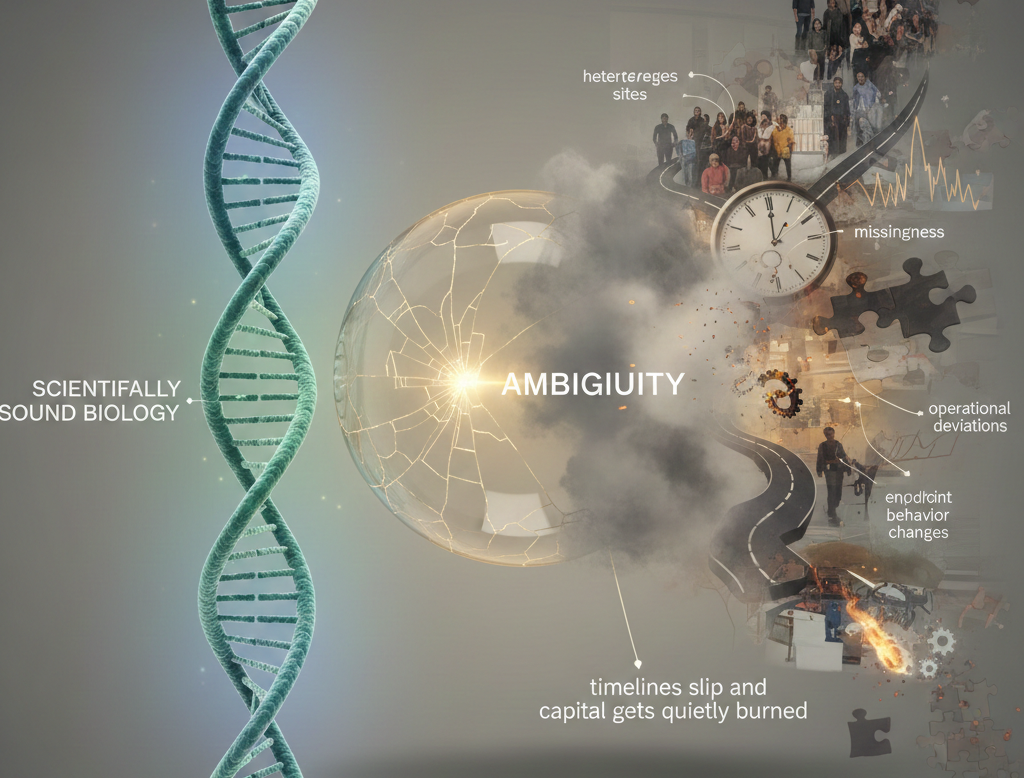
A protocol can be “scientifically sound” and still miss its milestone because the real world adds variance: heterogeneous sites, missingness, adherence drift, operational deviations, endpoint behavior changes.
If these aren’t stress-tested upfront, the program doesn’t necessarily fail cleanly—it becomes ambiguous—and ambiguity is where timelines slip and capital gets quietly burned.
If you don’t fix this (cost bullets)
- You lock a protocol that looks fine on paper—then recruitment starts and changes become expensive (or impossible).
- Power realism breaks under missingness, site variance, and heterogeneous response → diluted signal.
- You get pulled into an amendment cycle that burns timeline and sponsor confidence.
- You end up with a readout that’s hard to interpret → wrong go/no-go decision.
What you buy: a defensible decision trail for your milestone
Assumptions / Fragility Register (MRR)
Ranked “what must go right” assumptions tied to milestone exposure.
Scenario Pack (Drift Stress Tests)
Focused what-ifs: missingness, adherence, heterogeneity, site effects, operational variance.
Milestone Decision Note
Forwardable decision memo (IC / internal review ready): minimum fix set, trade-offs, and thresholds that change the decision.
Artifacts are inspectable (LaTeX/PDF), versioned, and reviewable—not slide decks or black-box outputs.
Audit tiers (pick the depth you need)
+ Protocol Blind-Spot Scan
+ Real-World Power Check (lite: variance + missingness + effective N)
Best for:
When you’re close to protocol lock and need a fast, decision-grade view of what breaks first—before early drift pushes you into an amendment cycle.
Outputs:
- Assumptions & Fragility Register (MRR) — lite, 1-page artifact
- Milestone Risk Snapshot — top fragilities + “fix-first” actions (what to change before lock)
Scope:
Top assumptions + first-break analysis + detectability under drift (variance, missingness, effective N).
Typical turnaround:
Fast (days)
Best when you need:
A clean “go / don’t go / fix first” view before sponsor alignment or internal lock.
+ Tier A
+ Regimen Robustness & Dose Decision
+ Transferability & Scaling Check
+ Measurement Decision Design (included when measurement choice is decision-critical)
Best for:
Milestones where the protocol must survive real-world variance (sites, behavior, missingness, heterogeneity)—and you want to lock with confidence, not hope.
Outputs:
- Assumptions & Fragility Register (MRR) (full)
- Assumptions Map (same artifact family—deeper view, not a different thing)
- Milestone Decision Memo (IC / internal review ready)
- Scenario Pack (Drift Stress Tests) — the minimal set of what-ifs that actually change the decision
Includes (standard scenario stress tests):
- Missingness + informative dropout
- Site-to-site variability / measurement drift
- Heterogeneity + effect dilution
Typical turnaround:
1–2 weeks
Best when you need:
You want the protocol to be defensible under drift and avoid mid-study redesign pressure.
+ Tier B
+ Reviewer-Ready Logic Pack (partner/regulatory-facing defensibility)
+ Mid-Study Amendment Decision (pre-plan)
+ Optional: Reusable model asset (documented I/O + scenario engine; code only if needed)
Best for:
High-exposure milestones (phase transitions, partner diligence, pivotal-like programs, or major capital at risk) where the real downside is not failure—it’s an ambiguous readout after major spend.
Outputs:
- Full Assumptions Map + Architecture + Scenario Pack (audit-grade)
- “What changes conviction” thresholds (what would actually flip the decision)
- Partner-ready logic appendix (traceable: claim ↔ endpoint ↔ timing ↔ decision rules)
- Optional reusable asset (documented I/O + scenario engine; code only if needed)
Includes:
Expanded scenario coverage + an audit trail suitable for internal governance and external scrutiny.
Typical turnaround:
Project-based
Best when you need:
The downside isn’t being wrong—it’s becoming ambiguous under scrutiny and variance.
Scope discipline: Stage-0 and audits test decision logic—not outcomes.
What decision are you facing right now?

Pick the gate you’re at today:
Modules (same library, packaged for biotech execution)
- Design • Review • Mid-Study • Post-Readout • Asset
Phase A — Design
Team question:
What breaks first once the protocol meets real sites and real behavior?
If you don’t do it:
you discover feasibility or endpoint fragility after spend starts.
You get:
assumptions register + first-break scenarios + minimum fix set.
Team question:
Are endpoints/biomarkers worth their cost and operational burden?
If you don’t do it:
expensive low-information panels add noise and missingness.
You get:
minimal must-measure set + timing windows + ROI notes.
Team question:
Will the regimen survive adherence drift and exposure variability?
If you don’t do it:
program “fails” because regimen fragility erased signal.
You get:
regimen scenario matrix + robust dose/interval options + defensible rationale.
Team question:
What transfers to the next context (phase, population, sites, real world)—and what breaks?
If you don’t do it:
you scale a result that collapses in the next setting.
You get:
transferability map + context-adjustment scenarios + scale-readiness notes.
Team question:
Will workflow and capacity constraints distort outcomes at scale?
If you don’t do it:
ops variance dominates measured effects.
You get:
bottleneck map + drop-off points + intervention what-ifs.
Not sure which block fits your situation?
Stage-0 helps you identify which decision risks actually matter before you invest further. You get a short written verdict — modelable as-is, modelable with changes, or not a fit right now — plus the lowest-effort next step.
Phase B — Review / Partner diligence
Team question:
Can we defend design logic under partner/regulatory scrutiny?
If you don’t do it:
rewrite cycles and delays hit your milestone timeline.
You get:
defensibility pack + assumptions log + claim↔endpoint alignment.
Phase C — Mid-Study
Team question:
What adjustment reduces risk without invalidating interpretability?
If you don’t do it:
amendment pressure leads to un-interpretable readout.
You get:
constrained scenarios + low-risk options + decision rationale note.
Guardrail:
We don’t replace ethics/regulatory oversight—scenario transparency only
Phase D — Post-Readout
Team question:
Null because biology failed—or because design drifted?
If you don’t do it:
you kill a viable program or fund the wrong v2.
You get:
divergence map + next-step options + test plan.
Team question:
Would this hold if rerun, audited, or reanalyzed?
If you don’t do it:
confidence collapses under scrutiny.
You get:
robustness metrics + sensitivity notes + audit-ready summary.
Team question:
What unmodeled factor likely shaped the readout?
If you don’t do it:
the next study repeats the same blind spot at higher burn.
You get:
candidate confounders + testable hypotheses plan.
Phase E — Asset
Inspect our math
Public, versioned artifacts—reviewable by peers.
De-identified examples on Zenodo and accompanying GitHub repos. Outputs are delivered in research-grade formats (LaTeX/PDF) suitable for citation and review—not marketing decks.
Enter Stage-0 (Team Intake)
Stage-0 is the first gate in our process. We review protocol logic and assumptions only—no outcome optimization.
You’ll get a short written verdict in ~1 business day: modelable as-is, modelable with changes, or not a fit right now, plus the lowest-effort next step.
Form fields (minimal):
- Team / role (Clinical Dev, Translational, Biostats, PM, BD)
- Decision gate (protocol lock / N&budget / regimen / diligence / mid-study / readout / asset)
- Short protocol synopsis (non-sensitive)

No sensitive data required for Stage-0.